In this article, we will be explaining how it is possible to achieve Real-Time Personalization by using Data Graphs. In order to understand why Data Graphs are so powerful, we need to get some context around Real-time Personalization. Firstly, we will explain the importance of delivering the right message at the right time. Then we will describe how Real-Time personalization can be executed with Data 360 (Data Cloud). Next, we will share why the Data Graph technology is a key component of Data 360 to achieve this Real-Time Personalization. We will also deep-dive into how the Data Graph method is more powerful than the generic method to retrieve information and provide some details on what is under the hood of a Data Graph, a relational database.
Delivering the right message at the right time
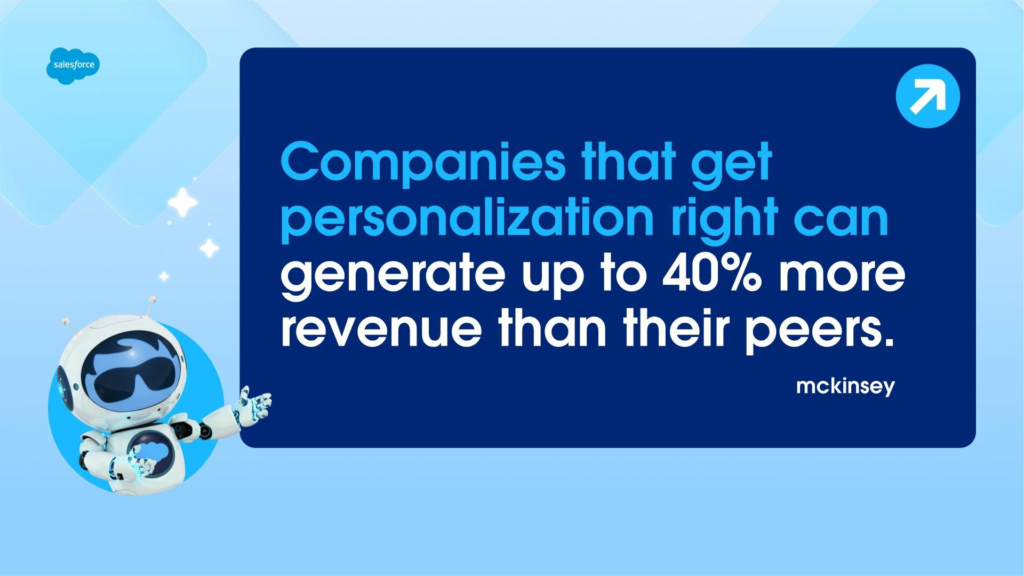
The best way to engage with a customer is to deliver the right message at the right time. However, in a society that is constantly evolving, understanding what is in the mind of the customer at time T is more and more complicated. According to McKinsey, companies that get personalization right can generate up to 40% more revenue than their peers.
Over the last decades companies were using information about customers that was stored from the past years, months, weeks or days but were unable to capture data and process it in real-time. Agentforce Marketing (Marketing Cloud Next) and Data 360 (Data Cloud) from Salesforce are now allowing us to do so in order to deliver a hyper-personalised experience in real time.
The accuracy rate of messages delivered to the customer is higher thanks to Real-Time Personalization as we are able to adapt the messaging based on the situation that the customer is experiencing at time T.
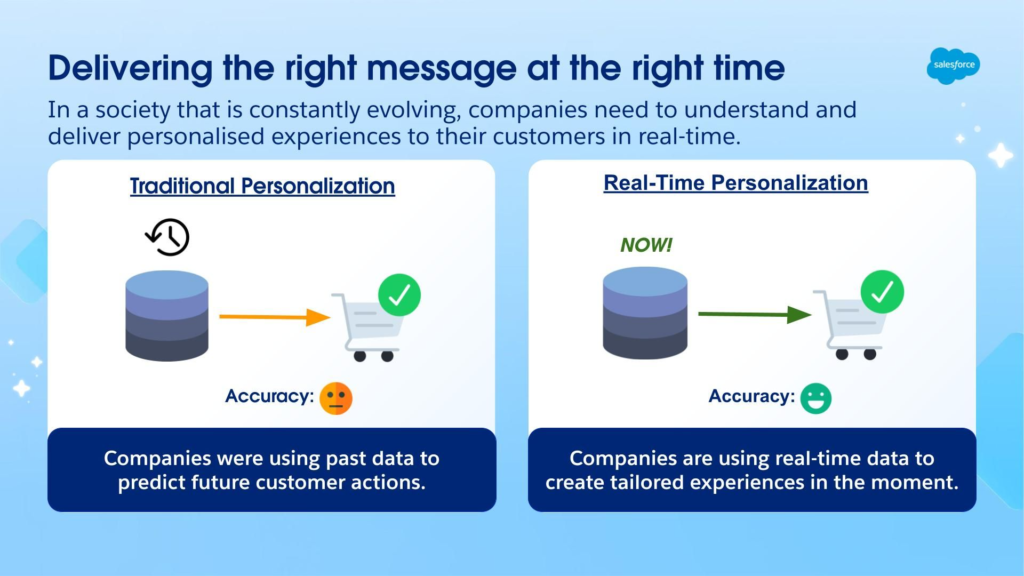
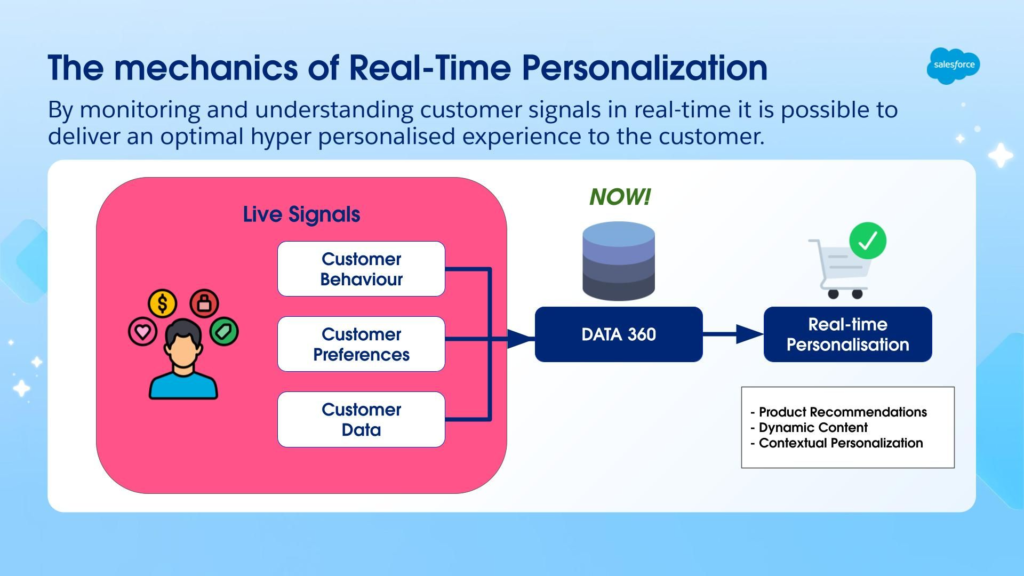
The mechanics of real-time personalization
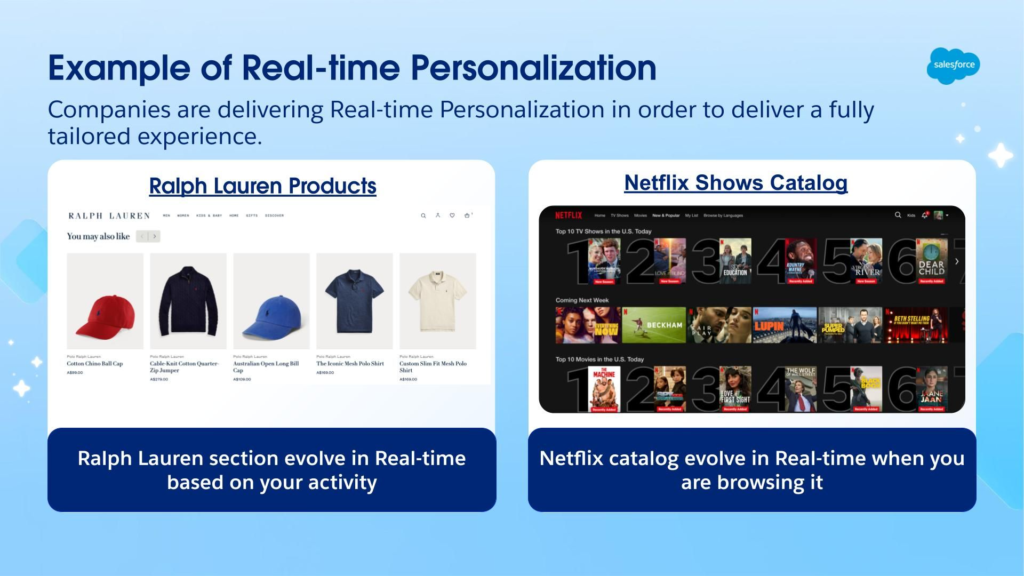
In order to achieve real-time personalization, we need to be capable of monitoring and aggregating customer signals and processing them in real-time. The data monitoring is built from components such as Customer Behaviour – how the customer is interacting with the website, Customer Preferences – what types of products, services, or communications (SMS, Email) the customer prefers, as well as Customer Data – what do we already know about the customer. These signals that are constantly changing are captured in Data 360 (Data Cloud) and processed in real-time, allowing us to populate key insights and deliver hyper-personalized experiences such as Product Recommendations (e-commerce section Recommended For You), Dynamic Content (i.e. Updates Netflix catalog as you are currently browsing it), and Contextual Personalization (Nearest Shop for Pickup based on where you live).
As examples, we can showcase the Product Section ‘You may also like’ on the Ralph Lauren website that will be updated in real-time based on the products that the user is viewing, the products added to the wish list, the cart, and products previously purchased. Similarly, the Netflix catalog evolves in real-time as you browse it based on the shows you have watched, the ones you have clicked on, or whose trailers you have watched.
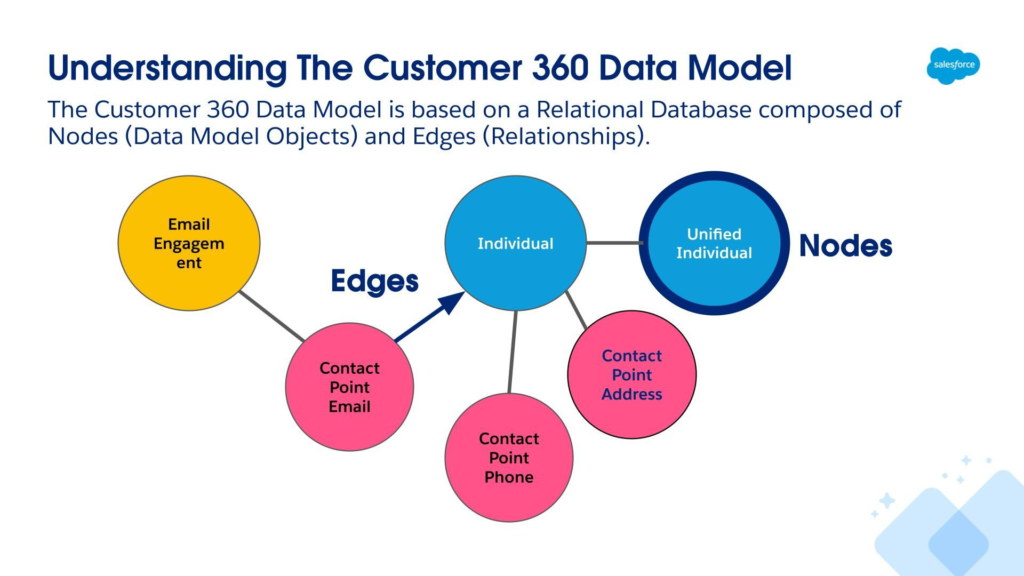
Understanding The Customer 360 Data Model
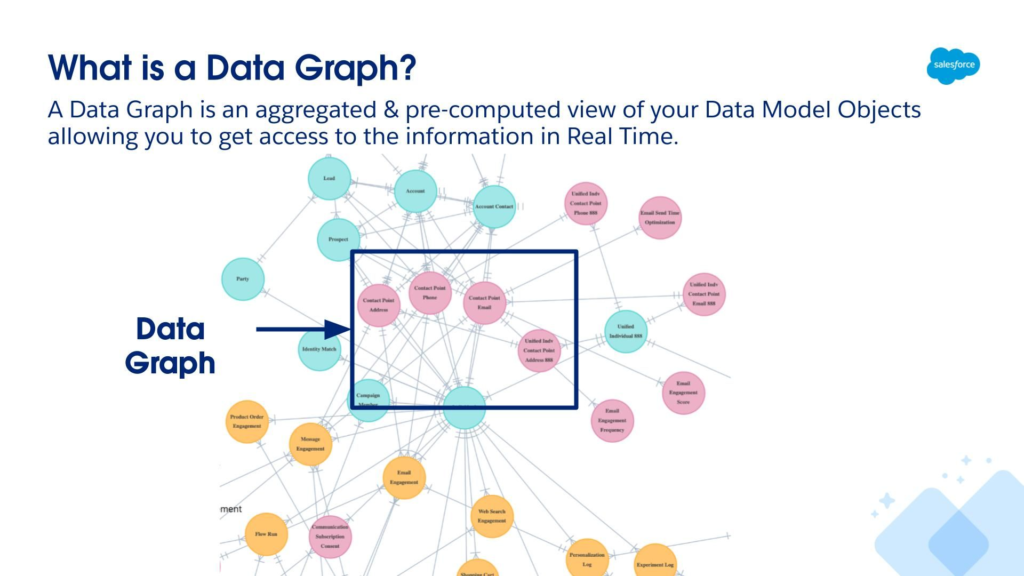
The Customer 360 Data Model is based on a Relational Database composed of Nodes (Data Model Objects) and Edges (Relationships).
A Relational Database is composed of nodes (i.e. Unified Individuals) and Edges (i.e. Relationships between Contact Point Email Node and Individual Node).
A Relational Database is designed to handle highly connected data and is well-suited for use cases where relationships between data are important.
What is a Data Graph?
The Data Graph in Agentforce Marketing is an aggregated view of your Data Model Objects that is pre-loaded, allowing you to access information quickly.
When using a Data Graph, the data stored in Data 360 is transformed into relatable everyday “things” that you want to ask questions about and can link together.
Because data in a data graph is pre-prepared, you can get the information you need in fewer steps. This means your data requests and queries show results almost instantly.
A data graph combines and transforms normalised table data from data model objects (DMOs) into new, materialised views of your data which can then be used in cross-platform use cases such as surfacing these views on a record in CRM or querying the graph from an internal platform.
Data Graph the Solution for Real-Time Personalization
The technology allowing us to deliver Real-Time Personalization in Data 360 and Marketing Cloud Next is named Data Graph. Data Graph is a pre-loaded database view that allows us to retrieve information faster than the generic method named Direct API Query.
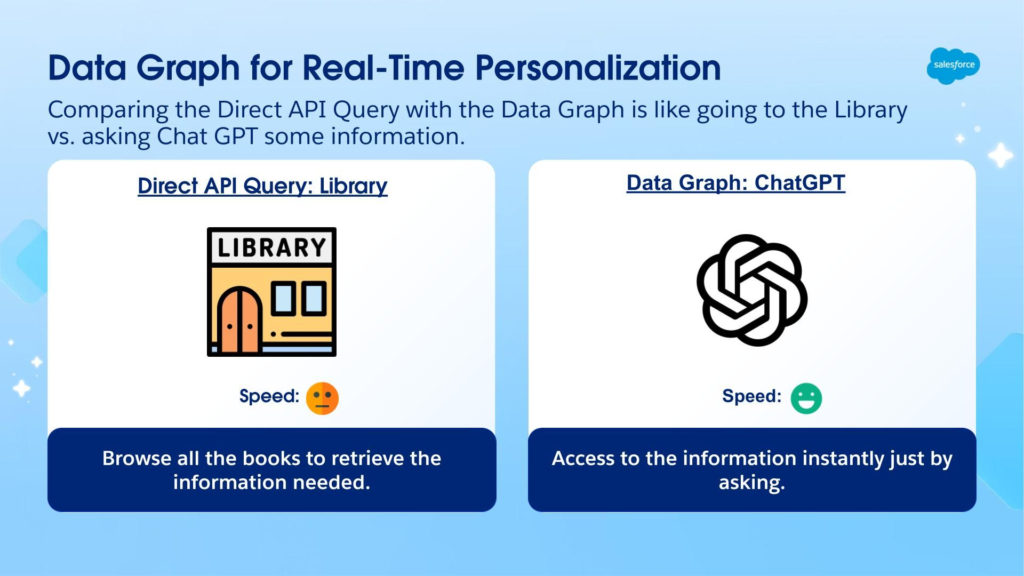
Direct API Query analyzes all datasets from your database from scratch before retrieving the right information. To illustrate, Direct API Query would be like if you were going to the library each time you wanted information about X. You would need to go through all the books until you retrieve the one needed.
On the other hand, Data Graph would be like if you were asking ChatGPT about the information X. The answer would be returned in real-time directly. Data Graph uses a pre-loaded and organized view of the data model objects that you need for a specific use case.
Agentforce Marketing Features supported by Data Graph
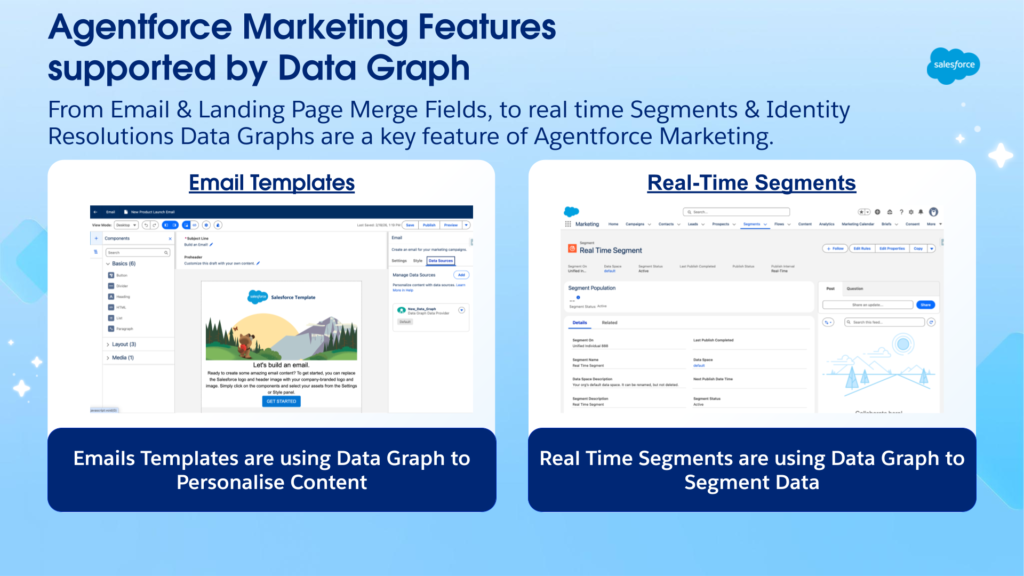
The beauty of Agentforce Marketing is that a lot of the features are supported by Data Graphs. Some of the features are Merge Fields in Email Templates to personalize content, Real-Time Segments that are dynamically updated based on criteria related to customers, and Identity Resolutions that unify customers across multiple platforms. By providing Data Graph technology, Agentforce Marketing is truly the platform that allows organizations to deliver real-time and tailored experiences to customers.
Understanding the difference between Standard and Real-Time Data Graph
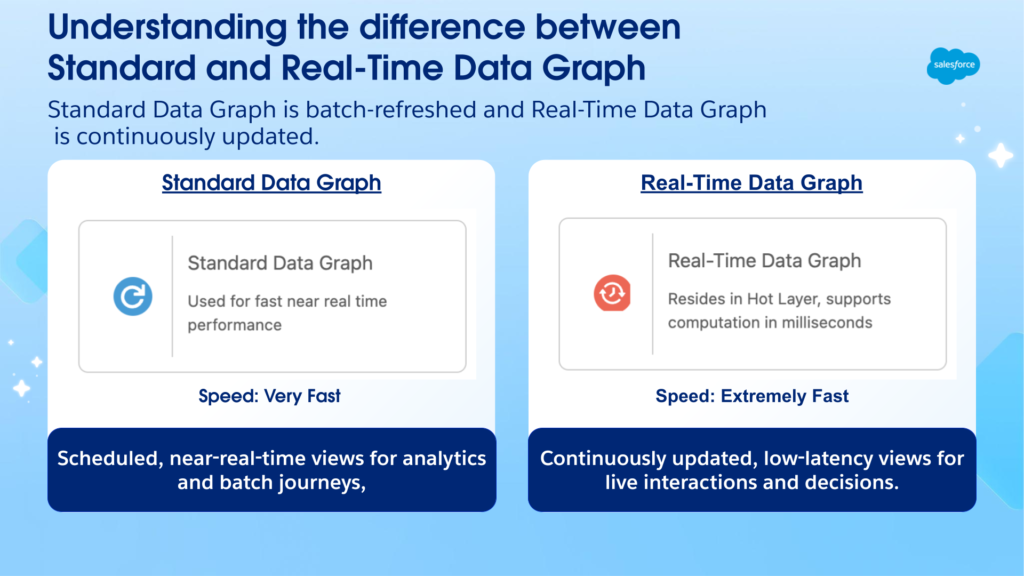
In Agentforce Marketing we can find 2 types of Data Graphs: the Standard Data Graph and the Real-Time Data Graph. Standard Data Graph is a pre-computed view of the Customer 360 Data Model that is refreshed every few seconds, which we call near-real-time. Standard Data Graphs are very useful for Marketing Journeys as well as analytics.
The Real-Time Data Graph is refreshed every few milliseconds. The Real-Time Data Graph should be exclusively dedicated to use cases that require real-time experiences such as a customer communicating with an AI agent via voice. In this type of scenario, the AI agent needs to have updated and accurate data about the customer in order to deliver an excellent real-time experience.
The Anatomy of a Data Graph Configuration
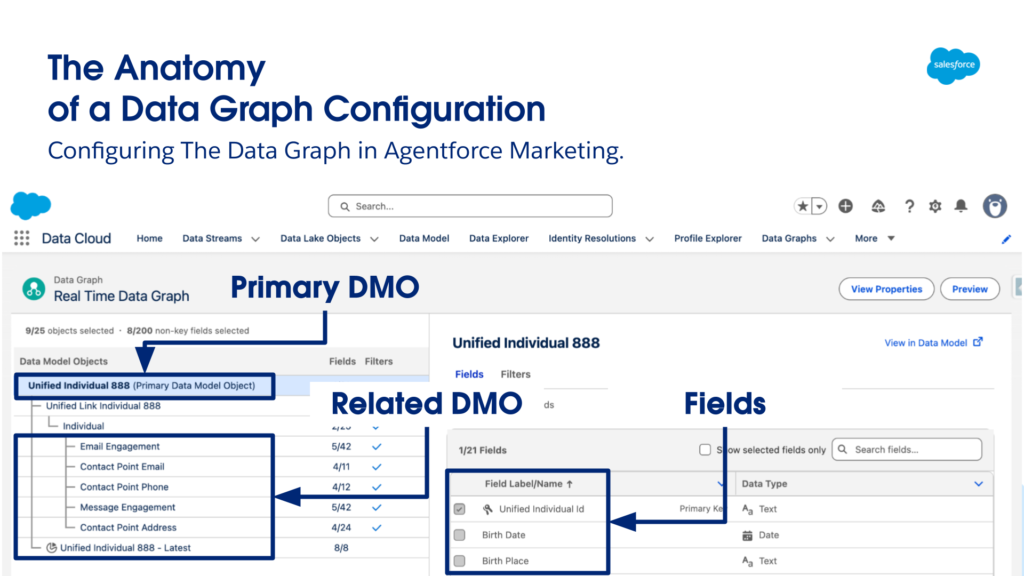
A Data Graph is composed of a Primary Data Model Object from the Customer 360 Data Model, as well as some Related Data Model Objects. Most of the time the selected Primary Data Model Object will be the Unified Individual that represents one person across multiple systems (i.e. Your customer John Smith has profiles stored in multiple platforms, which is why he exists as a unified individual). Related Data Model Objects represent all the information categories you need to know about your customer, such as email address, phone number, and contact information. All of this information needs to be included in your Data Graphs, as well as the fields for each Primary/Related Data Model Object that you select.
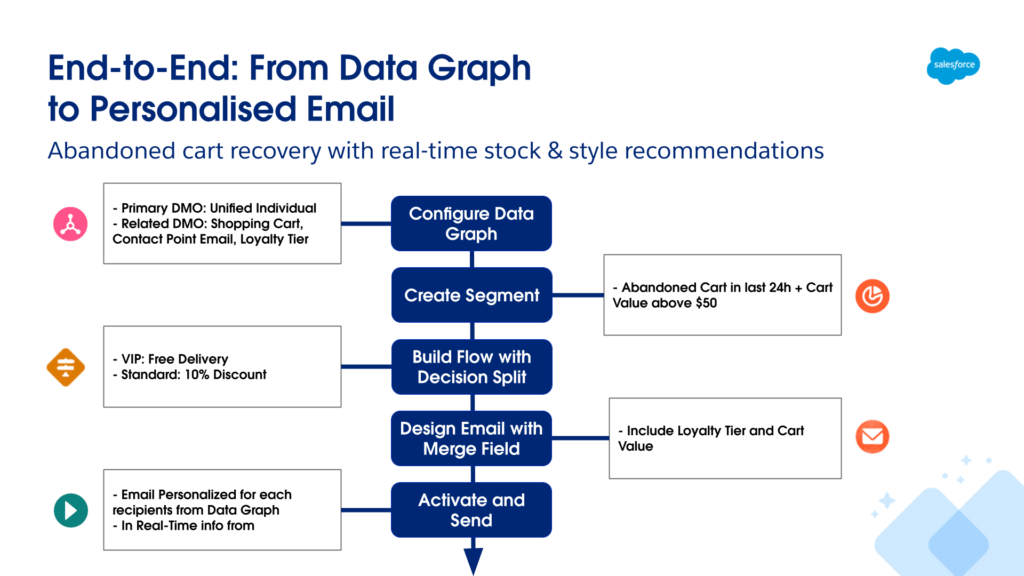
End-to-End: From Data Graph to Personalised Email
To provide a concrete example of how the Data Graph can be used to deliver personalized content in real time, I will use an abandoned shopping cart scenario. Initially, we will need to create a Data Graph that includes Data Model Objects related to the customer such as Email, Shopping Cart, and Loyalty Tier. Next, I will populate a Real-Time Segment that identifies customers with an Abandoned Cart over the last 24 hours with a value above $50. Next, I will create a Campaign Flow in Agentforce Marketing with a decision split and two paths based on the Loyalty Tier Data Model Object used in our Data Graph. The two paths will be VIP and Standard. Next, I will create an Email Template for Abandoned Cart using Merge Fields that rely on the Cart Value and Loyalty Tier. Finally, I will activate my recurring Campaign Flow. The result will be an Abandoned Cart email sent to my customer with updated and accurate information populated in the email thanks to the Data Graph.